
Pressure Measurement
Understanding Pressure Specifications for Pressure Transducers
There are several specifications that are commonly used to describe pressure transducers to help the user determine if the transducer is suitable for a particular application. All of these relate to the main specification for a pressure transducer which is its full-scale measurement range. Validyne transducers are available in differential, gauge and absolute versions – the maximum full scale pressure range is given in the model number and data sheet.
Full Scale Pressure: This is the maximum pressure the transducer can measure to the accuracy stated in the spec sheet. This is also known as the calibrated pressure range. Validyne transducers calibrated at the factory will have a calibration sheet showing the full-scale pressure. Validyne sensors calibrated in the field similarly will have a full-scale pressure range determined by the user.
Over-Pressure: The over-pressure limit is the pressure that can be applied to the transducer without compromise to subsequent measurements. For Validyne transducers, this is generally twice the full-scale pressure range. A transducer calibrated for 0 to 2.0 psid, for example, will have an over-pressure rating of 4.0 psid. A pressure above 2.0 psid will drive the transducer signal above its calibrated full scale reading and eventually peg out at some off-scale value. If the applied over-pressure is less than 4 psid, and once the pressure comes back within the full-scale measurement range, the transducer should read correctly.
The over-pressure value cannot exceed the burst pressure (see below). The effect on the accuracy of the transducer after an over-pressure event is also given in the specification. For differential pressure transducers, the over-pressure may be applied in either the plus or minus directions. For absolute pressure transducers with a low full scale pressure range, the overpressure limit is 20 psia – a bit above ambient atmospheric pressure. This means that the over-pressure limit for absolute transducers is 2X full scale or 20 psia, whichever is greater.
For gauge pressure calibrations it is often possible to condition the sensor to accept overpressures greater than twice full scale, because the over-pressure will always come from the same direction. The amount of additional over-pressure that can be tolerated – and the resulting error – will depend on the full-scale range of the sensor, so check with Validyne for details.
Static Pressure Rating: Validyne differential pressure transducers can measure small pressure drops at high static line pressures. The standard line pressure rating for our sensors is 3200 psig. That means a transducer might be reading a differential pressure of 1 psid in an orifice flow application with a line pressure of 3000 psig applied to both the plus and minus ports. The sensor body and seals must be capable of operating continuously at 3000 psig. Most Validyne transducers can operate at a static pressure of 3200 psig, but we have other versions that can operate much higher – to 12,500 psig.
A static pressure applied to an operating transducer will increase the zero-shift error slightly. For general purpose transducers, this is typically 1%/1000 psi.
Note: The static pressure rating is different than the over-pressure rating!
A transducer with a full-scale calibration of 0 to 2 psid will have an over-pressure rating of 4 psid, even though the static pressure rating is 3200 psig. If the full static pressure should be accidentally applied to one side of the DP sensor with atmospheric pressure on the other side, the sensor will be damaged. A three-valve manifold, however, will allow the transducer to be put into operation safely.
Burst Pressure: Burst pressure is the maximum pressure the sensor can withstand without failing or leaking. For most Validyne transducers this is greater than 4000 psig. Validyne
transducers will not burst, but at some point, above 4000 psig the O-ring seals in the sensor body may extrude, causing the transducer to leak. Various transducer models may have different limitations – please consult Validyne if you are not sure.
Proof Pressure: Proof pressure is the pressure a transducer has been subjected to during testing in order to verify its working pressure. Validyne general purpose sensors are not tested to failure, so they can be said to have aproof pressure of 3200 psig.
In Summary:
Full Scale Pressure: The calibrated pressure range of the transducer.
Over-Pressure: The maximum pressure in excess of the full-scale pressure that can be tolerated without compromise to subsequent measurements. This is normally 2X full scale pressures and 20 psia (ambient atmosphere) for low-range absolute transducers.
Static Pressure: The maximum working pressure of the transducer body. For Validyne general purpose transducers this is normally 3200 psig.
Burst Pressure: The pressure at which the transducer will fail and leak. This is greater than 4000 psig for Validyne general purpose transducers.
Proof Pressure: The pressure the transducer is subjected to during factory testing. This is typically 3200 psig for most transducers.
Some Examples:
A P55D transducer calibrated 0 to 100 In H2O full scale will have:
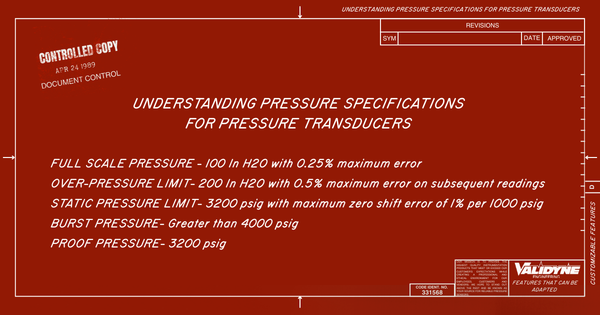
Full Scale Pressure – 100 In H2O with 0.25% maximum error
Over-Pressure Limit – 200 In H2O with 0.5% maximum error on subsequent readings
Static Pressure Limit – 3200 psig with maximum zero shift error of 1% per 1000 psig
Burst Pressure – Greater than 4000 psig
Proof Pressure – 3200 psig
A P55A transducer calibrated 0 to 1 psia full scale will have:
Full Scale Pressure – 1 psia with 0.5% maximum error
Over-Pressure Limit – 20 psia (ambient atmosphere) with 0.5% maximum error
Static Pressure Limit – Does not apply to absolute transducers
Burst Pressure – Greater than 4000 psig
Proof Pressure – N/A
A DP15 sensor calibrated 0 to 2500 psid full scale will have:
Full Scale Pressure – 2500 psid with 0.25% maximum error
Over-Pressure Limit – 4000 psid with 0.5% maximum error (cannot exceed burst limit)
Static Pressure Limit – 3200 psig on either or both ports
Burst Pressure – Greater than 4000 psig
Proof Pressure – 3200 psig
Understanding the difference between full scale pressure, over-pressure, static pressure rating, burst pressure, and proof pressure isn’t just technical housekeeping, it’s what prevents a misapplied sensor from becoming a damaged or dangerous one. These specifications work together to define not just what a transducer can measure, but what it can survive. When in doubt, the safest approach is to verify the ratings for your specific model against your actual operating conditions before installation.
If you’re not sure which pressure ratings apply to your application or need help selecting a transducer for a high static line pressure system, a low-range absolute measurement, or anything in between, Validyne’s engineering team can walk you through it.


Leave a reply
You must be logged in to post a comment.