Aerospace, Pressure Measurement
How to Calibrate Differential Pressure Sensors in Extreme Cold
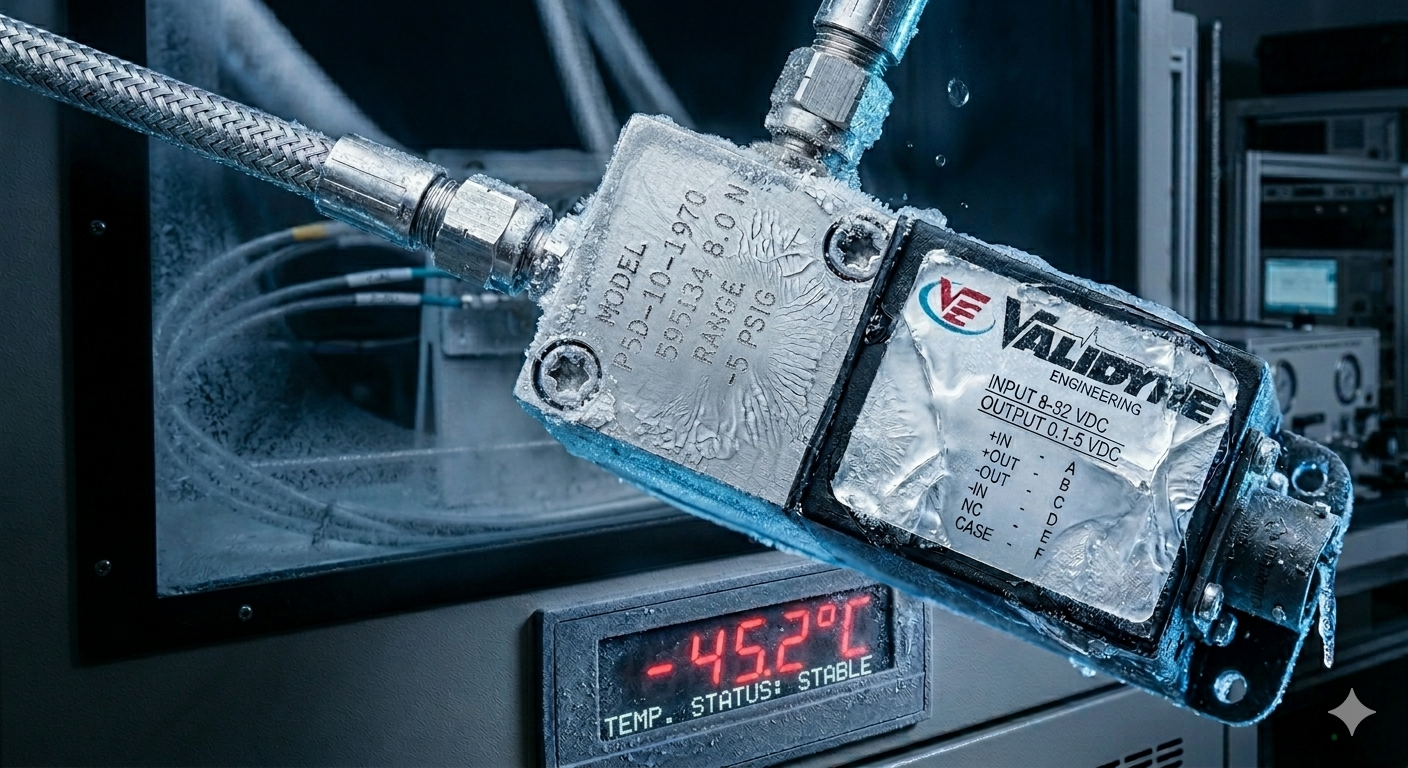
Calibrating pressure sensors at very low temperatures, especially below -20°C, is a challenge for many manufacturers. Metals contract; mechanical stresses intensify causing traditional strain-gauge sensors to drift significantly.
Validyne’s VR-based differential pressure sensors behave differently. Our variable reluctance sensors are made from metals whose coefficients of thermal expansion and contraction are matched, minimizing stress during extreme temperature changes. But even with VR advantages, extreme cold calibration requires specialized techniques
Here’s how it works, why it’s difficult, and best practices Validyne follows
Why Cold Calibration Is Difficult for Most Sensors
- Different Material Contraction Rates Change Sensor Behavior
All metals contract at low temperatures. In strain-gauge sensors, this affects:
- Adhesives
- Bonded foil grids
- Backing materials
- Beam structures
Temperature changes lead to unpredictable offset shifts and result in pressure measurement errors.
With VR sensors, the only moving part is a solid metal diaphragm, with a thermal coefficient matched to the sensor body material so cold effects are far less drastic and more repeatable.
- Oil Fill Fluids Become Viscous
MEMS and strain-gauge sensors often use silicone oil or gel behind their isolation membranes. At low temperatures, silicone oil viscosity changes dramatically, slowing dynamic response and increasing hysteresis.
Validyne VR sensors have no internal oil fill, so this issue does not exist.
- Electronics Drift at Low Temperature
Amplifiers and signal conditioners drift when very cold. This can reduce the accuracy of the pressure readings.
Validyne minimizes this with stable AC excitation, temperature compensation and matched coil design.
How Validyne Performs Calibration at Low Temperatures
Step 1: Condition the Sensor for Temperature Equilibrium
A sensor must soak at the target temperature long enough for all the parts to reach thermal equilibrium. This includes the sensor
- Diaphragm
- Body
- Coils
- Electronics
Validyne typically uses a 30-to-90-minute soak cycle depending on sensor size and mass.
Step 2: Apply Known Calibration Pressures Slowly
Rapid application of pressure at low temperatures can shock the diaphragm or cause transient offsets. Validyne applies pressure gradually to:
- Stabilize magnetic flux changes
- Reduce mechanical overshoot
- Ensure consistent diaphragm deflection
Step 3: Capture Both Upscale and Downscale Data
Cold can affect the downscale pressures differently than the upscale path. Validyne always captures complete calibration data:
- Increasing pressure
- Decreasing pressure
to fully characterize sensor linearity and cold hysteresis.
Step 4: Analyze Zero Shift and Span Shift Errors Independently
Cold effects are often more pronounced in zero shift errors. VR sensors typically:
- Hold span well
- Shift zero modestly
- Return to normal after temperature normalization
Best Practices for Customers
- Avoid Applying Rapid Environmental Temperature Changes
Rapid Freeze → heat → freeze cycles can induce stress.
- Recalibrate after extreme environmental testing
If a sensor has been cold soaked, recalibrate after returning to room temperature.
Calibrating differential pressure sensors for extreme cold can be difficult — but VR sensors offer significant advantages. Our solid metal diaphragms and sensor materials are thermally matched, have dry interiors, and stable A/C excitation circuits. VR sensors outperform oil-filled or strain-based sensors in extremely cold environments.
Validyne’s factory calibration process ensures accuracy and stability, even in the most demanding temperature conditions.
Cold calibration isn’t something every sensor manufacturer can do well, and for applications where measurement accuracy has to hold at -40°C or below, the sensor technology itself matters as much as the calibration process. VR sensors start with a structural advantage: matched thermal coefficients, no oil fill, and a single moving part that behaves predictably across a wide temperature range. Pair that with a methodical soak-and-step calibration process, and you get a sensor you can trust when the temperature drops.
If your application involves extreme cold, whether that’s cryogenic testing, outdoor environmental monitoring, or aerospace, Validyne can calibrate your sensor to your specific temperature range and document the full upscale and downscale performance. Contact us to discuss your low-temperature requirements →
Related posts

Aerospace, Pressure Measurement
Preventing Pressure Port Contamination – Best Practices for Long-Term Performance
Pressure port contamination is one of the most common — and preventable — causes of sensor failure. Dust, oil mist, particulates, biological debris, or corrosive materials entering the pressure ports…
Aerospace, Oil & Gas
How to Choose a Differential Pressure Sensor for Industrial Gas and Steam Monitoring
Industrial gas and steam systems require precise pressure measurement to ensure safe, efficient operation. These environments are challenging due to high temperatures, vibration, condensation, and corrosive media. Selecting the right…
Aerospace, Data Acquisition
How to Integrate Validyne Pressure Sensors With NI, LabVIEW & Dewesoft
Many pressure measurement applications rely on software ecosystems like NI LabVIEW, NI DAQ hardware, or Dewesoft acquisition systems. Validyne VR sensors integrate seamlessly into these environments — but successful integration…
Aerospace
Pressure Measurement Challenges in Aerospace Engine Test Cells and How VR Sensors Solve Them
5 Major Pressure Measurement Challenges in Engine Test Cells 1. Extreme Vibration Engine startups, compressor stalls, and turbine harmonics generate intense shock loads that can push conventional sensors to their…
Aerospace, medical, Pressure Measurement
Understanding Zero Drift, Span Shift & Long-Term Stability and Differential Pressure Sensors
Pressure sensor accuracy isn’t determined only at the moment of calibration. Over days, weeks, or years, every pressure sensor experiences some degree of zero drift, span shift, and long-term stability…Comments are closed