Aerospace, Oil & Gas, Utility
Temperature Isolation of Pressure Sensors
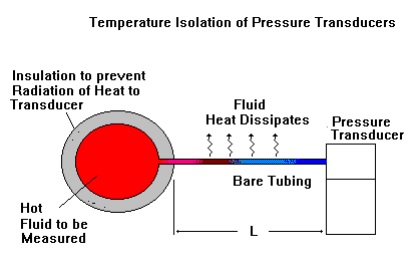
Frequently it is necessary to measure the pressure of fluids which at temperatures above or below the rated operating range of the available pressure transducers. The expense of a special transducer can often be avoided if the pressure sensor is isolated from the pressure source by a short length of pipe or tubing. See how Temperature Isolation can help improve the data you are looking for.
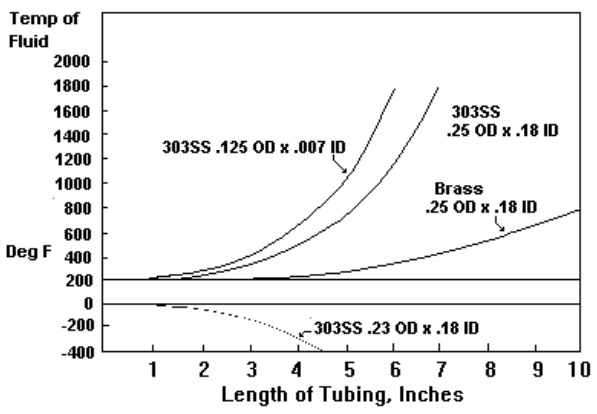
The graph below shows the lengths of tubing needed to limit the temperature at the transducer to a range of 0 deg F to 200 deg F for fluid temperatures between -400 deg F and +1700 deg F. The curves are based on the following assumptions:
- The piping is insulated to limit radiant heat transfer to the transducer. The major source of thermal input to the sensor is by conduction through the connecting tubing.
- The pressure media has a coeffieicnt of thermal conductivity less than 0.4 BTU/hr/ft/deg F. This includes a wide range of liquids and gases.
- The ambient air temperature around the transducer is not greater than 100 deg F.
- The heat transfer rate from the bare tubing to still air is 1.44 BTU/sq ft/hr/deg F.
There is no flow of fluid through the tubing to the transducer, therefore the only path for heat transfer is conduction. Because the tubing is not insulated and the ambient air temperature is less than 100 deg F, the heat dissipation of the tubing protects the transducer, even to extremes in temperature of the fluid to be measured.
Related posts

Aerospace, Pressure Measurement
Preventing Pressure Port Contamination – Best Practices for Long-Term Performance
Pressure port contamination is one of the most common — and preventable — causes of sensor failure. Dust, oil mist, particulates, biological debris, or corrosive materials entering the pressure ports…
Aerospace, Oil & Gas
How to Choose a Differential Pressure Sensor for Industrial Gas and Steam Monitoring
Industrial gas and steam systems require precise pressure measurement to ensure safe, efficient operation. These environments are challenging due to high temperatures, vibration, condensation, and corrosive media. Selecting the right…
Aerospace, Data Acquisition
How to Integrate Validyne Pressure Sensors With NI, LabVIEW & Dewesoft
Many pressure measurement applications rely on software ecosystems like NI LabVIEW, NI DAQ hardware, or Dewesoft acquisition systems. Validyne VR sensors integrate seamlessly into these environments — but successful integration…
Aerospace
Pressure Measurement Challenges in Aerospace Engine Test Cells and How VR Sensors Solve Them
5 Major Pressure Measurement Challenges in Engine Test Cells 1. Extreme Vibration Engine startups, compressor stalls, and turbine harmonics generate intense shock loads that can push conventional sensors to their…
Aerospace, medical, Pressure Measurement
Understanding Zero Drift, Span Shift & Long-Term Stability and Differential Pressure Sensors
Pressure sensor accuracy isn’t determined only at the moment of calibration. Over days, weeks, or years, every pressure sensor experiences some degree of zero drift, span shift, and long-term stability…Comments are closed