medical
Differential Pressure Sensors for Respiratory and Ventilation Measurements
Respiratory equipment demands some of the most precise, stable, and low-range pressure sensing in any field of instrumentation. Ventilators, spirometers, and pulmonary diagnostic instruments all rely on accurate differential pressure measurement to calculate airflow and lung volume in real time — and the margin for error is as small as the pressures being measured.
Validyne’s variable reluctance (VR) sensors have been used in medical and biomedical systems for decades, chosen for their unmatched stability and repeatability at the very low pressures generated by respiratory airflow.
Why Differential Pressure Works for Respiratory Flow Measurement
Flow through a restriction creates a pressure drop proportional to flow rate. Pneumotachs — the flow elements used in most respiratory instruments — are designed with very low resistance so that normal breathing is neither impeded nor masked by the measurement device itself. A typical pneumotach generates a differential pressure of just 2 cm H₂O at maximum flow. Measuring that pressure accurately, without moving parts, is what makes differential pressure sensing ideal for this application.
Pneumotachs are available in several flow ranges, from adult athletes down to premature infants, making them adaptable across the full spectrum of respiratory care.
Common applications include:
- Ventilators and ICU respiratory monitoring
- Sleep study respiratory monitoring
- Spirometry and pulmonary function testing
- CPAP and BiPAP device testing and validation
- Anesthesia flow control
- Biomedical research on lung mechanics and breathing patterns
Why Validyne VR Sensors Excel in Respiratory Systems
1. Extremely low-pressure capability Some respiratory flow measurements require ranges under ±1 inch H₂O. Validyne designs and machines diaphragms specifically for these ultra-low pressure ranges, with the sensitivity and resolution to capture subtle changes in patient airflow.
2. Patient safety VR pressure transducers are electrically isolated from the patient by the air-filled tubing connected to the pneumotach, no direct electrical contact with the patient circuit.
3. Excellent repeatability across high cycle counts Respiratory systems are highly cyclical, a ventilator or monitor may complete thousands of pressure cycles per day. VR sensors have no bonded strain gauge elements to fatigue or creep over time, maintaining accuracy long after strain-based sensors would have drifted.
4. Low hysteresis, no elastic memory Solid metal diaphragms don’t exhibit the creep or elastic memory of bonded or polymer-based sensing elements. What the sensor reads on the way up, it reads accurately on the way down.
5. Compatibility with standard flow elements Validyne VR sensors integrate directly with pneumotachs, orifice plates, and laminar flow elements, the most common flow measurement devices used in respiratory instrumentation.
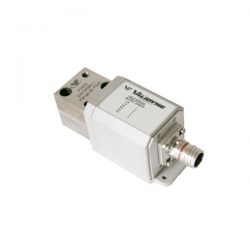
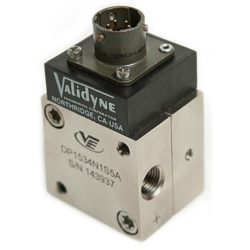
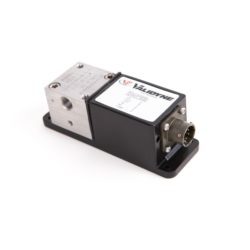
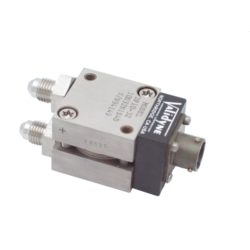
For respiratory and biomedical applications, Validyne’s DP45 Low Pressure Variable Reluctance Sensor is the purpose-matched choice. Designed specifically for extremely low differential pressure measurement in the range of ±1 inch water column, the DP45 is used extensively in flow measurement applications where dynamic response at low flow rates is critical.
A few features that make it well-suited to respiratory instrumentation:
- Pressure range of ±0.6 to 90 in. H₂O full scale — covering the full spectrum from premature infant respiratory monitoring to adult exercise spirometry
- Low internal volume and small volumetric displacement — minimizing dynamic line pressure effects and ensuring the sensor doesn’t interfere with the flow it’s measuring
- Symmetrical construction — reduces sensitivity to mounting orientation and vibration
- High natural frequency — enables accurate capture of fast respiratory waveforms
- Field-replaceable sensing diaphragms — the DP45 can be disassembled for cleaning, diaphragm replacement, or range changes without returning the unit to the factory
- All wetted surfaces are corrosion-resistant steel — compatible with the humid, warm airflow conditions of respiratory circuits
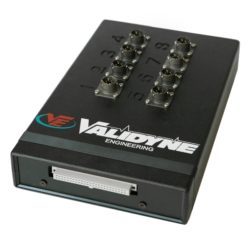
Paired with a Validyne CD Series carrier demodulator, the DP45 produces up to ±10V output from pressure inputs as low as 0.6 in. H₂O — giving you the resolution to capture even subtle changes in patient airflow with confidence.
Example: Ventilator Flow Measurement
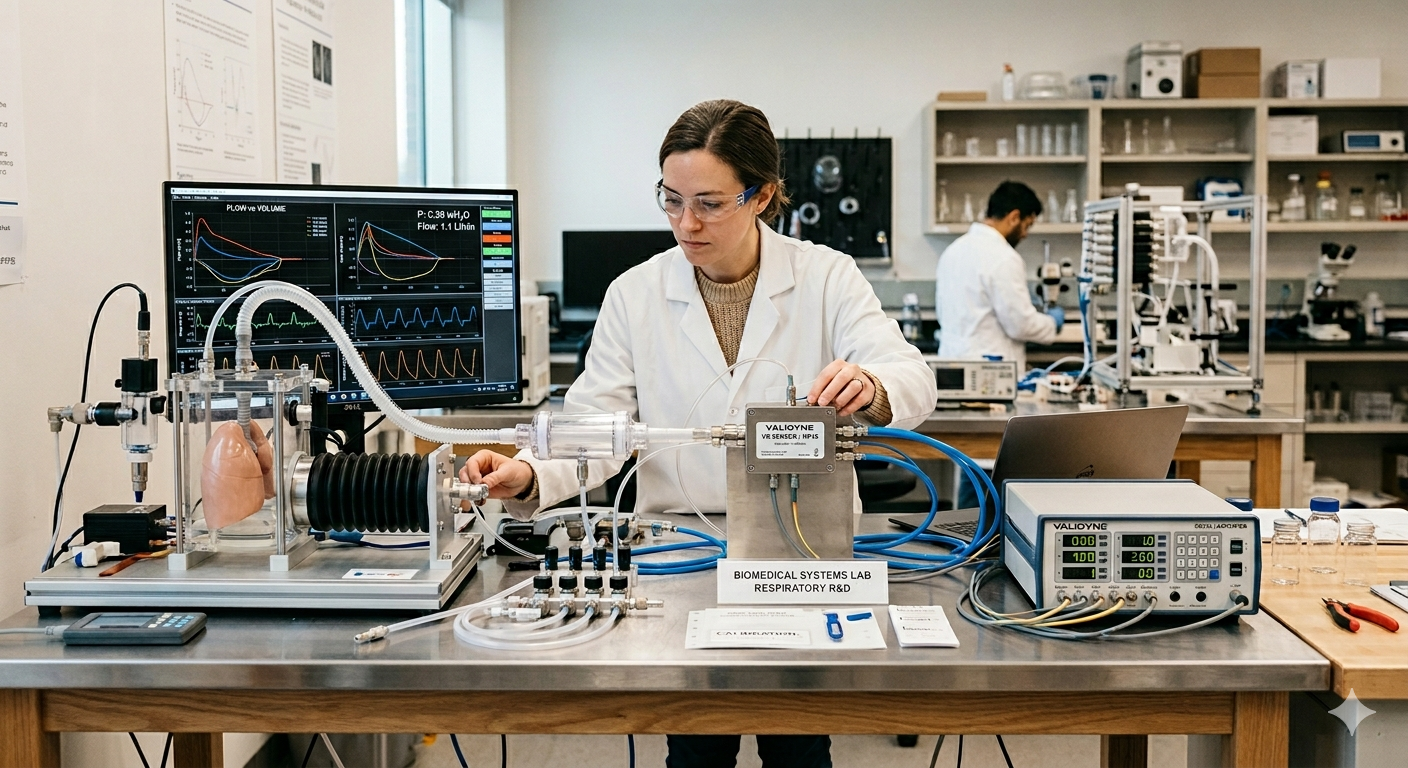
A ventilator measuring airflow across a laminar flow element might see a differential pressure of just 0.30 inches H₂O. Using a calibrated VR sensor paired with a Validyne CD Series signal conditioner, the system translates that pressure into real-time airflow data. An optional electronic integration module continuously calculates lung volume throughout the respiratory cycle, enabling the generation of flow/volume curves used in the diagnosis of obstructive and restrictive lung diseases.
Respiratory measurement sits at the intersection of the most demanding technical requirements and the highest possible stakes, patient safety. A sensor that drifts, fatigues, or introduces hysteresis errors isn’t just an instrumentation problem; it’s a clinical one. Validyne’s VR sensors have earned their place in medical and biomedical systems because their all-metal construction, ultra-low-pressure capability, and cycle-after-cycle repeatability hold up where it matters most, from ICU ventilators to sleep study labs to pulmonary research.
If you’re developing or sourcing sensors for a respiratory or biomedical application, Validyne’s engineering team can help you select the right pressure range, signal conditioner, and configuration for your system. Contact us to discuss your application →
Related posts
Aerospace, medical, Pressure Measurement
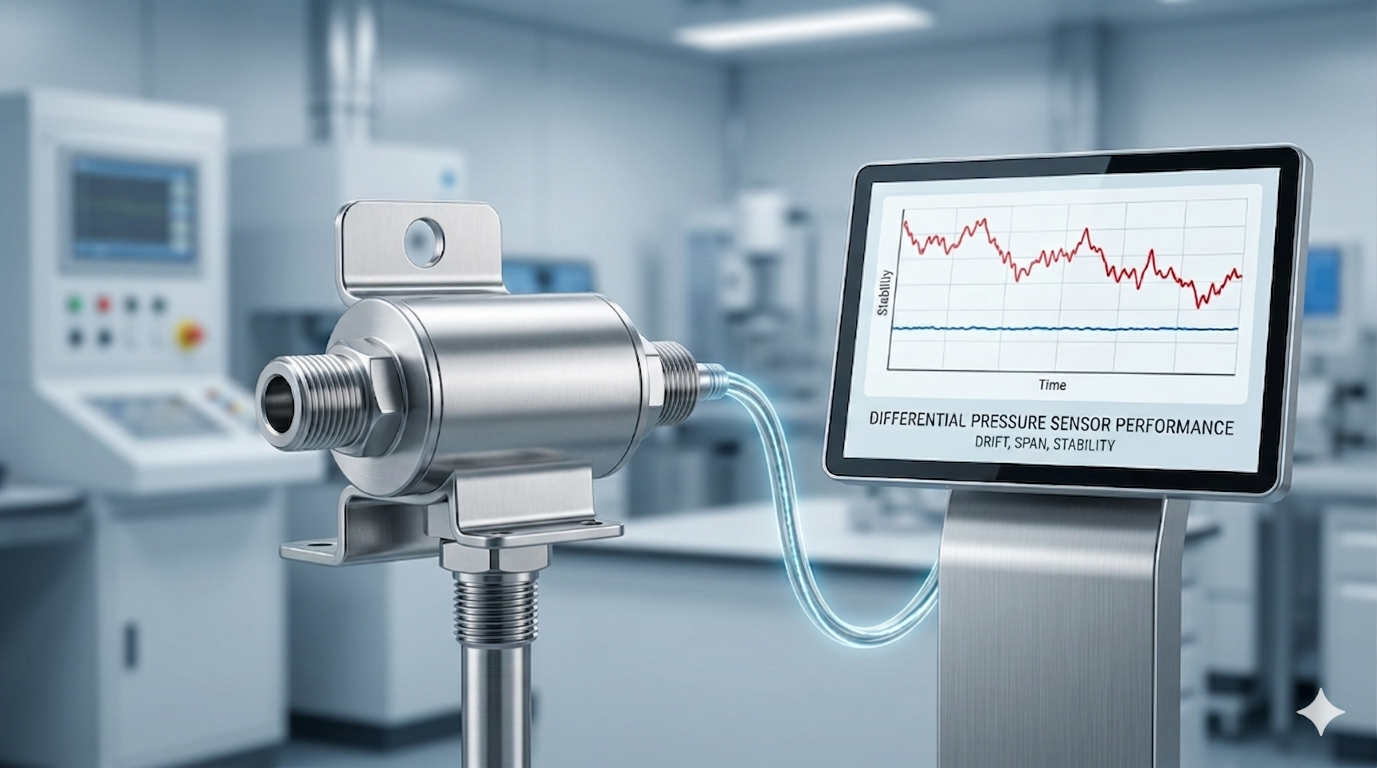
Understanding Zero Drift, Span Shift & Long-Term Stability and Differential Pressure Sensors
Pressure sensor accuracy isn’t determined only at the moment of calibration. Over days, weeks, or years, every pressure sensor experiences some degree of zero drift, span shift, and long-term stability…
medical
Setting the Standard: Validyne’s Legacy in Portable Respiratory Testing
When it comes to respiratory diagnostics, precision is critical—especially in assessing muscle strength in patients with neuromuscular or chronic respiratory conditions. In a notable 1994 clinical study, a newly developed…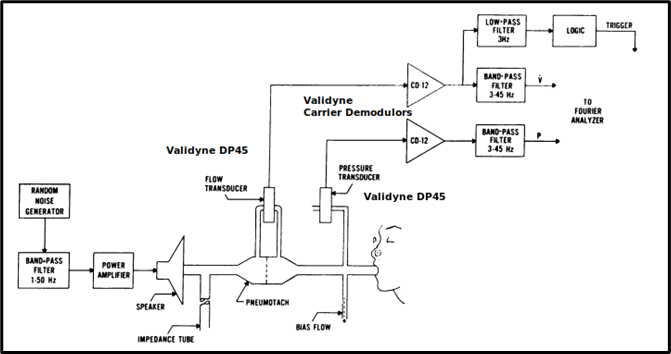
medical
Advancing Pulmonary Research: How Validyne Equipment Aided Spectral Analysis
Advancing pulmonary research often requires innovative approaches and reliable tools. In a 1975 study “Pulmonary Mechanics by Spectral Analysis of Forced Random Noise,” Edward D. Michaelson, Eric D. Grassman, and…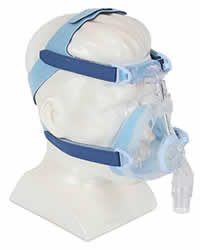
medical, University
PS309 Used to Test CPAP Mask
Sleep apnea is common sleep disorder in which breathing repeatedly stops and starts. This is most commonly caused by the relaxing of throat muscles or, more rarely, when the brain…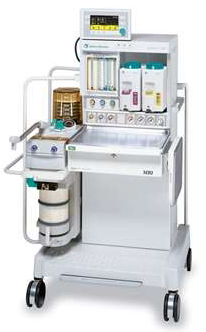
medical
Anesthesia Delivery Systems
One method of administering anesthesia to surgical patients on the operating table is via a vapor delivery system. In this method the anesthesia is poured into a vaporizer as a…Comments are closed